Inventors

Bioventures' Pathway to Patents

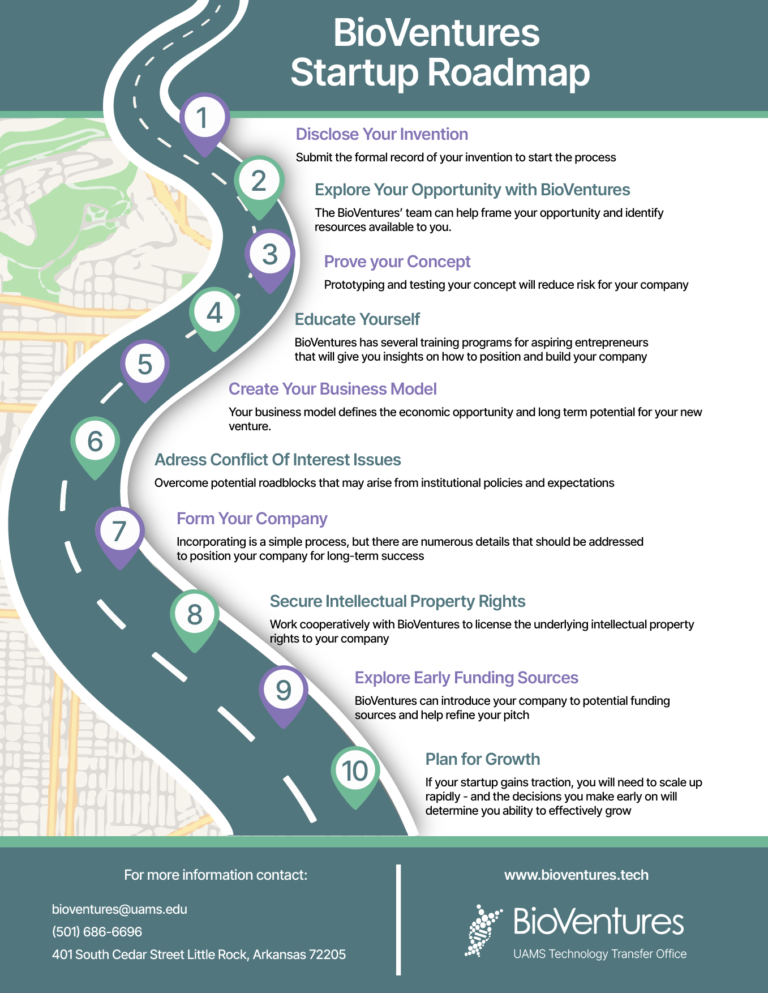
The invention disclosure process can be overwhelming at times, which is why we have broken down the step by step process for you. Here you can read the timeline in a simple and clear way. If you are an inventor, click here to read a more detailed description of the process.

Step 1
Invention Disclosure

Submit the invention disclosure form stating the current status of your invention.


Step 2
Technology Assessment Report

Our team will complete the TAR, a structured summative document regarding your invention. This includes a snapshot of colesely related inventions, and preliminary market analysis.

Step 3
Technology Assessment Deck

The slide deck helps us focus the technology assessment report even more and allows us to send the information to individuals in the industry to help us assess the technology.

Step 4
Patent and Copyright Committee Presentation

The Bioventures team preset the technology to the Committee with the collaboration of the inventor.

Step 6
Determination

After the Patent and Copyright Committee meet, there are 3 possible determinations. 

Start now!

To start the process, the first step is to fill out the Invention Disclosure Questionnaire. Log in to Wellspring Sophia and click “Login through UAMS”.

Latest News and Updates

Innovation
Bioventures Team

New Patent Enables Enhanced Viral Production Using Engineered Human Cell Lines 

What’s the problem?  Viruses are essential tools in modern biotechnology, with applications in cancer immunotherapy, gene therapy, and vaccine development. However, producing viruses efficiently at clinical and commercial scale remains a major bottleneck. Many commonly used human cell lines, including the widely adopted A549 line, retain natural antiviral defense mechanisms that limit viral replication, resulting in lower yields and increased manufacturing costs.  One key antiviral factor is the human protein SAMD9, which restricts viral replication inside host cells. Its presence significantly reduces the efficiency of producing certain therapeutic viruses, including oncolytic viruses such as myxoma virus. This limitation slows research, clinical development, and commercialization of promising viral therapies.  What does this technology do?  This patent covers engineered human cell lines modified to eliminate or reduce expression of the antiviral host factor SAMD9, enabling significantly enhanced viral replication in vitro. By removing this natural antiviral restriction, the modified cells allow viruses to replicate more efficiently, increasing overall production yields.   The technology can be implemented using gene-editing approaches such as CRISPR-Cas9 to generate stable, virus-permissive cell lines suitable for research, clinical development, and manufacturing. These engineered cells have demonstrated improved production of oncolytic viruses, which are increasingly used as targeted cancer therapeutics and immunotherapies.  By improving viral replication efficiency, this innovation has the potential to:  This platform provides a practical and scalable solution for enhancing viral production using human cell lines compatible with therapeutic applications.  Inventor  Jia Liu, PhD, Associate Professor in the Department of Microbiology and Immunology at University of Arkansas for Medical Sciences (UAMS).

See More »
Blog
Bioventures Team

Applications Now Open for BioVentures’ Medical Innovation and Entrepreneurship Honors Track (MIEHT) 

The MIEHT program offers structured training in need identification, customer discovery, problem triaging, and iterative solution development. Through seminars, hands-on exploration, and mentorship, students gain practical experience in evaluating clinical challenges and advancing innovative concepts that can improve patient care and healthcare system efficiency. 

See More »

Subscribe to our Newsletter

Stay tuned with BioVentures’ newsletter for inventors: news, events, resources and more!

* indicates required