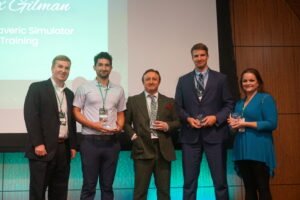
UAMS students Rodrigo Meade, Smyan Kothapally, Tayler Appleton, Shivani Koundinya and Cameron Taylor won both the Biodesign Competition and the People’s Choice Award in Toronto with ARGUS, a project designed to reduce radiation exposure for physicians during image-guided procedures.
Built around a simple but urgent problem, daily exposure to scatter radiation during image-guided procedures, ARGUS transforms a standard ceiling-mounted lead shield into an intelligent safety device that helps guide positioning in real time. The project grew out of UAMS’s interventional radiology innovation community and reflects the kind of translational, problem-driven thinking encouraged through MIEHT and supported by the broader BioVentures innovation ecosystem.
Below, the team shares more about the clinical need behind ARGUS, the path that led to the project, and what winning in Toronto means moving forward.
Q: What is ARGUS, and what problem is it designed to solve?
A: ARGUS is a radiation safety device designed to better protect physicians working in interventional suites. During image-guided procedures, operators are exposed to scatter radiation every day, and although shielding is available, it is not always positioned optimally in real time. ARGUS transforms a standard ceiling-mounted lead shield into an intelligent safety device that helps guide positioning during procedures, with the goal of improving protection and reducing unnecessary radiation exposure to the operator.
Q: What inspired your team to pursue this idea?
A: What inspired us most were the real, personal stories of cataracts in interventional radiology. Once we started learning more, the problem became impossible to ignore. We were drawn to the idea because it was not just a technical challenge, but a human one. We wanted to work on something that could meaningfully protect the people who dedicate their careers to caring for others.
Q: What was the biggest challenge, and how did you overcome it?
A: Radiation is difficult to solve for because it is largely invisible in the moment, and the consequences can take years to appear. We spent a lot of time talking with people across the field and learning from their experiences, concerns, and workflows. Those conversations helped us better understand what matters in practice and pushed us to simplify the solution into something that could realistically fit into the procedural environment.
Q: How did the Biodesign Club and Interventional Radiology Special Interest Group contribute to the project?
A: The Biodesign team is part of the Interventional Radiology Special Interest Group, since the competition is centered around innovation in IR. Being part of that environment at UAMS gave us the chance to work on a meaningful problem in a field that is constantly evolving.
Q: In what ways did MIEHT help prepare you for this experience?
A: MIEHT helped prepare us not only by teaching us how to think through innovation more intentionally, but also by helping us believe that projects like this were possible. It gave us exposure to design thinking, clinical problem-solving, and the process of translating an idea into something real. Just as importantly, it connected us with the right people and showed us the incredible innovation potential that exists at UAMS and across Arkansas.
Q: What does winning both awards mean to your team?
A: Winning both awards meant a tremendous amount to our team. It was incredibly rewarding to be recognized alongside outstanding teams from places like Yale, Emory, and NYU, and it made us especially proud to represent UAMS on that stage. Winning the People’s Choice Award made it even more special because it showed that the project resonated not only with the judges, but with the broader audience as well.
Q: What comes next for ARGUS?
A: The next steps are to continue refining the concept, gathering more feedback from clinicians and technical mentors, and further developing the prototype in a way that reflects real interventional workflow. We are excited to keep building on this momentum and continue pushing ARGUS toward something that could one day make a real difference in practice.
Interested in MIEHT? Applications are open through May 15, 2026.
Applications for the Medical Innovation and Entrepreneurship Honors Track (MIEHT) are open through May 15, 2026. Students interested in learning more about the program, eligibility, and how to apply can find additional information on the MIEHT program page.